
Tungsten carbide vs mild or tool steel
Carbide stays clean and fine grained, while steel rusts, pits and shows a coarser surface.
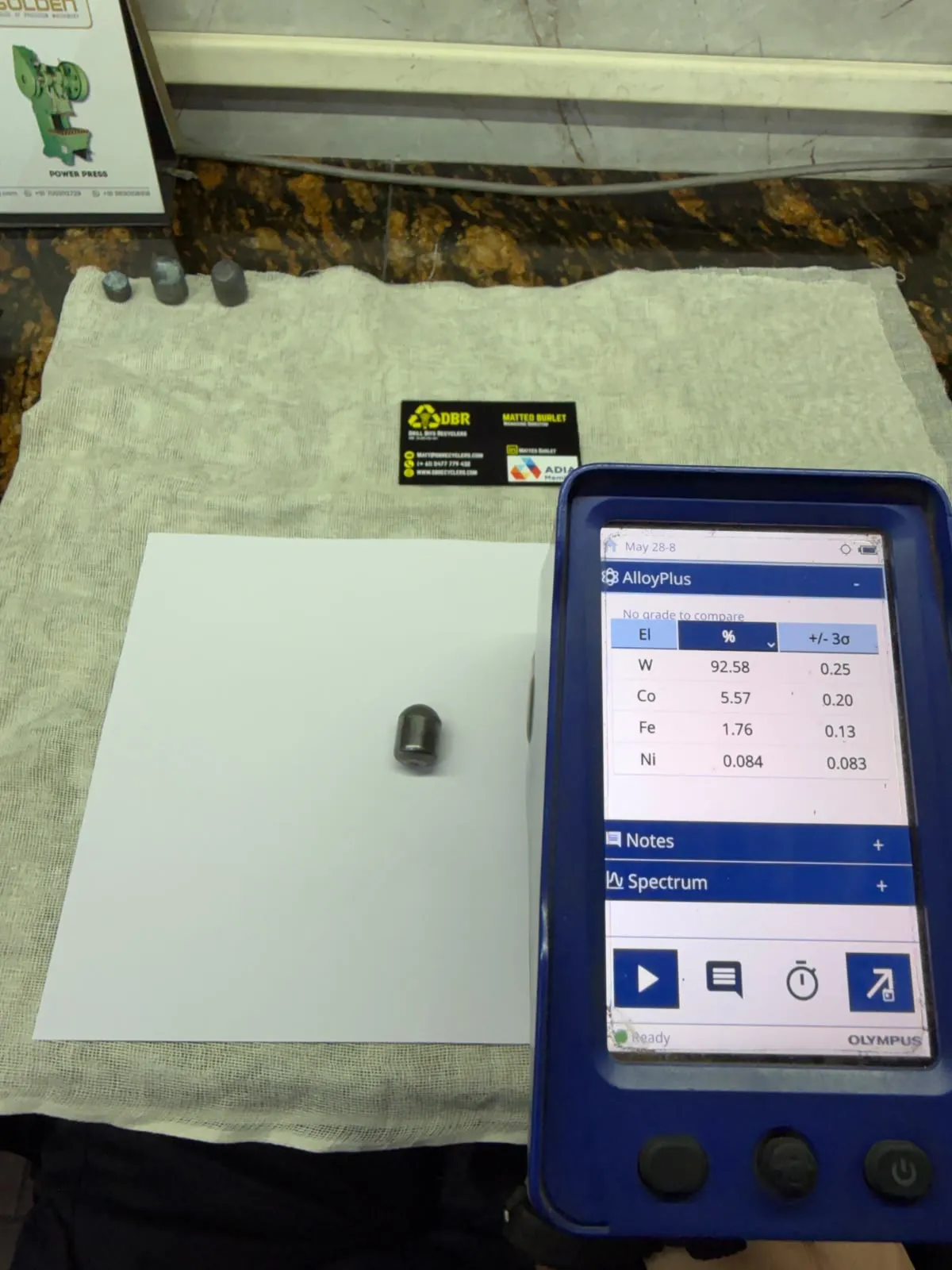
XRF testing can identify the elemental composition of tungsten carbide and other specialty alloys when visual checks do not settle the grade. Drill Bits Recyclers reserves it for material that warrants closer assessment. The five field checks below help you decide what to separate before sending a photo.
Tungsten carbide can be lost in a mixed steel pile when nobody separates it before pricing. A quick check for density, magnetism, sparks, surface wear and a braze line helps identify what should be set aside.
These checks provide a first read. Send a clear photo if the result is uncertain.
Using the XRF allows us to identify materials correctly and pay our customers properly for high value scrap rather than guessing. It is reached for when a load genuinely needs it, not run as a matter of course on everything that comes through the gate.
Once material is identified, what it is worth depends on grade, how much contamination or attached steel is mixed through it, and the tonnage involved, checked against the current tungsten reference. We do not publish a flat rate because those variables change from load to load; the straightest path to an answer is sending a photo and letting us look at what you have actually got.
Any load that goes ahead is weighed and documented the same as every other job at Malaga, and settled by EFT once the weight and grading are confirmed.
These five checks identify the most obvious differences between carbide and steel. A precise elemental result may require XRF, which reads alloy composition directly.
If the checks do not settle it, send a clear photo. We will look at what you have got and tell you the next step.
Tungsten carbide is roughly twice as dense as steel for the same size piece. A small piece that feels heavier than it looks is a strong first clue.
Step 1Mild and tool steel pull hard on a magnet. Cobalt bonded carbide is usually only weakly magnetic, and nickel bonded carbide even less so, so a weak or absent pull points away from plain steel.
Step 2Touch the piece to a grinding wheel. Mild steel throws a long, bright spray of sparks. Carbide throws few sparks or none at all, often just a dull, short burst at the point of contact.
Step 3A hardened file will scratch mild or tool steel without much effort. Genuine tungsten carbide is hard enough that a file skates across it and leaves no mark.
Step 4If there's a visible braze line where a harder looking tip meets a steel body, that tip is very likely a separate carbide insert, brazed on rather than machined from the same piece.
Step 5Tungsten carbide is roughly twice as dense as steel for the same size piece. A small piece that feels heavier than it looks is a strong first clue.
Mild and tool steel pull hard on a magnet. Cobalt bonded carbide is usually only weakly magnetic, and nickel bonded carbide even less so, so a weak or absent pull points away from plain steel.
Touch the piece to a grinding wheel. Mild steel throws a long, bright spray of sparks. Carbide throws few sparks or none at all, often just a dull, short burst at the point of contact.
A hardened file will scratch mild or tool steel without much effort. Genuine tungsten carbide is hard enough that a file skates across it and leaves no mark.
If there's a visible braze line where a harder looking tip meets a steel body, that tip is very likely a separate carbide insert, brazed on rather than machined from the same piece.
The checks above will tell you whether something is worth a second look. A clear photo is the practical next step.
The range moves with the metal and the impact category studied, once it has been correctly identified. No yard-specific reduction is claimed.
Run the checks above, then send us a photo of what you’ve got. We’ll tell you what it looks like and what the next step is.